|
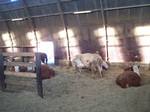
Loose stall stable. It is good for legs and claws | |
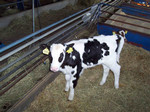
A calf kept in straw. | |
Health
Milk fever:
Milk fever is a production disease which mainly affects older, high producing cows. The majority of milk fever cases occur within 48 to 72 hours of calving although some may occur in late lactation.
- The disease is caused by to little calcium and magnesium in the blood. Because before calving, when the cow is dry, the need of calcium and magnesium is very low. Then, when the milk production starts suddenly the need of calcium gets higher. The body doesn’t manage to prepare the high need of calcium. Because when you feed the cow too much calcium in the dry period before, she can’t use the reserves from the bones.
- The symptoms of milk fever could be that they will eat less, their muscles will shake uncontrollable, they will get unsteady or eventually they won’t rise. Their body temperature will be low, constipation may occur and they will die, if you don’t give them fast and right treatment.
- Treatment
The veterinary has to come and give the cow an injection with calcium and water, so the calcium level in the blood rises.
How to prevent milk fever
-
Feed the cows the first 46 days of the dry period a ration that’s pore of calsium and magnesium.
So the cow is used of make her own calsium and magnesium. And the last 14 days of here dry period start to feed her calsium and magnesium rich ration so she has enough reserves to use the first 3 days after calving, and after that she’ll start to make her own again.
When you keep her ration pore of calsium and magnesium until she is calving, she’ll have a lag of calsium and magnesium because her body is out of optimal factionary and she isn’t able to make her own calsium and magnesium.
Grass Tetany:
Mainly high producing cows and cows on pastures get grass tetany.
- Grass Tetany occurs when the level of magnesium in the blood is below a critical level. Then the magnesium in the liquid, which surrounds the brain and spinal cord, decreases too. If there is too much potassium in the food, the cow will take in less magnesium than usually.
- Symptoms
The muscles of the body can not work properly and so they get muscle spasms. When they are stressed they will get these spasms, then cannot breathe anymore and die.
- Treatment
When it is very bad you have to call the veterinary, which gives the cow an injection with magnesium.
- Prevention
Before you take the cows out to the pastures, you have to feed them extra magnesium. And if it is necessary you can give extra mineral around the summer and also during the indoor feeding season. In the beginning of pasture season you can give sugar feed, hay or straw. That helps absorption of magnesium.
Phosphor losses:
High producing cows often haven’t got enough phosphor.
- Phosphor losses occur when you don’t cut the grass in time and if you use to less fertilizer.
- Symptoms
The cows, which have phosphor losses, get softer bones and lower fertility. They also eat less food and give less milk. Their metabolism is getting bader and they get thinner.
- Treatment
They get an injection with phosphor and you must feed much phosphor to them.
- Prevention
You have to feed the cow enough phosphor and use fertilizer with phosphor.
Selenium losses:
New born calves often get selenium losses and cows get only ten percent of their daily need through grass, hay or silage. So those losses often occur by cows on pastures.
- Selenium is important for the cell metabolism and to catch harmful substances. Selenium losses appear if diseases don’t get better even with professional treatment.
- Selenium improves immunity of cows
- Symptoms
Calves with selenium deficiency react to everything and drink their milk, but they can’t turn orders of the brain into actions because their muscles are underdeveloped. By elder cows the back is bent and they breathe very fast.
- Treatment
The cow gets a selenium injection from the veterinary.
- Prevention
You have to feed enough mineral feed. Maybe take blood tests and check the diets.
- The best way to prevent selenium losses is to added selenium to fertilizers
Page updated 12.4.2006 |
|



