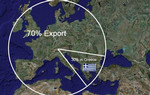
Export | |
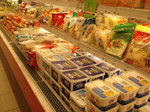
In the supermarket | |
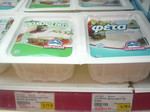
plastic packages with Feta | |
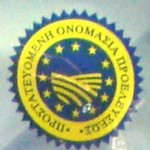
Quality seal | |

Very delicious! | |
Marketing of Feta
Possibilities of Marketing
The cheese producer has more opportunities to sell his product. He has to find the most efficient way to sell the cheese and to get a fair price. One possibility is to sell the cheese at his own shop at the farm. This is a big risk, because sometimes there are more, and sometimes no customers to buy the cheese. Another way to sell is to make a contract with a local supermarket. There is much less risk for the farmer, because the contract binds the supermarket to pay for a certain amount of cheese. The same you can do with a restaurant or another company that exports the cheese. It is distributed to the market in barrels, tin boxes or in the form of plastic-wrapped pieces and is consumed as table cheese in the famous Greek salad.
Export
The main importer of Greek cheese is Germany. This country absorbs almost 50% of the cheese exported by Greece, while USA comes second with an almost 10% share. The countries that follow are: Italy (about 9%), UK (about 5.5%) and Australia (about 5%). Other European countries absorb the remainder 20%.Year by year, the exports of Greek cheese mark a gradual rise. The rising export trends are expected to continue in the years to come. The possibilities for the Greek cheese penetration to new markets are huge. Undoubtedly, the exceptional quality of Greek cheese is an assurance for achieving the best results.
Importance for Greece
Cheese production is the most significant sub-sector of the Greek dairy industry. Although there were restructuring and modernizing trends in recent years, Feta production still is an important part for the little dairy farms. The average annual consumption of Feta in Greece is more than 26 kg, which is the highest in the world.
Measures of Protection
The name Feta is internationally protected, but there are some companies which try to copy the Feta. The quality seal “PDO” (Protected Designation of Origin) tries to save the origin of real Greek Feta. That means that production and processing of a product in a special region must follow a certain fixed procedure.
Back to Feta / Regional products
Page updated 30.3.2007 |



