
Pasteurisation of the milk | |
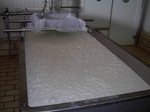
Coagulation of the milk | |
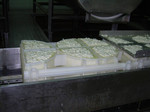
Curd in the moulds | |
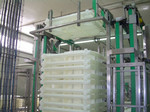
Turgning over the moulds | |
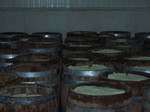
Barrels for storage | |
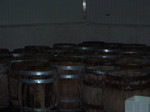
Maturing chambers | |
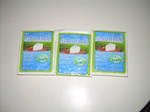
Vaccumated Feta | |
Production of Feta
Content:
Sheep and goat milk
Feta is a high quality cheese, conserved in brine, in sliced form.
Feta is prepared from sheep milk or a mixture of sheep and goat milk (not over 30% goat milk). The milk comes from sheep and goat races, which are traditionally raised and adapted to the region where their diet is based on the local flora. Both kinds of milk are mainly produced in Greece’s mountainous regions.
Production procedure:
Milk is collected by producers and brought to the cheese dairy. The milk coagulation has to occur within 48 hours from its collection. First, sheep and goat milk is pasteurised. There are two ways to pasteurise the milk.
1) Slow pasteurisation: in 68ºC for 10 min
2) Fast pasteurisation: in72ºC for 15 sec
Afterwards milk is refrigerated at 34-36ºC. Then lactic acid starter cultures and chloride calcium are added and coagulation should occur in 45-60 mins.
As soon as milk coagulation is complete, the curd is cut in small cubes and left for 10 minutes. The curd is transferred into moulds, which are stored at a temperature of 16-18ºC for 18-24 hours. During this period, they are periodically turned over for better draining.
Maturation:
The next day cheese is removed from the moulds and placed either in wooden barrels or metal containers, where it is salted in layers, so that final concentration of salt in the mass of cheese is roughly 3%.
After 2-3 days, cheese is placed into barrels or other containers with brine, containing 7% sodium chloride (NaCl). They are transported into the maturing chambers with a temperature of 16-18ºC and very high relative humidity, where they remain for 10-15 days. During this time feta’s characteristics in taste, look and smell are developed. At the end of the first stadium of maturing, Feta’s water content is lower than 56%, and its ph ranges between 4,4-4,6.
The second stage of maturing, lasts about 6 weeks where feta is transported into refrigerators with a temperature of 2-4 degrees Celsius.
The total maturing time of Feta lasts until 2 months, Addition of any form of powder or condensed milk, milk proteins, casein salts, colour, conservatives and antibiotics to either milk, Feta or brine is strictly prohibited.
Conservation:
Until it is sold, Feta is conserved in refrigerators with a temperature of 0-2ºC. During its conservation in metal containers or wooden barrels, it must be covered with brine containing 7% salt, and contact with air must be avoided. This way, the cheese keeps its freshness and characteristic smell and taste.
Feta can then be sold to the consumer straight out of the barrel or metal container. Another way of conserving the Feta is in airtight packages or in containers where feta is preserved in its natural brine.
Back to Feta / Regional products
Page updated 30.3.2007 |



