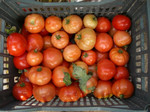
Tomatoes | |
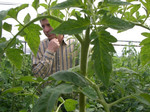
The boss of the tomatoes | |
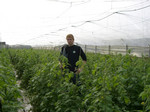
Wow...so many plants! | |
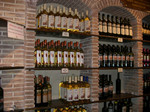
Wine, wine, wine... | |
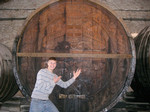
Mine! | |

Best part of life! | |
Interesting! | |
other products: Wine and tomatoes
Production of organic tomatoes in greenhouses:
In Greece it’s very common that tomatoes grow up in a greenhouse. Because of the white plastic the humidity and the temperature can be held constant. The farmers in Greece graft the plants. They prefer wild types as a rootstock because they are very strong and they aren’t so predisposed to diseases than other plants.
For howling the temperature of about 13°C the farmers use a plastic cover (in the night and the different seasons). The humidity gets regulated by using warm water irrigation, its 90% during the night and 60% during the day.
The farmers of greenhouses get their plants from special organic companies of young plants. The distribution between the crop area and the amount of plants is about 2000 plants/ha. The tomatoes get fertilized by bumblebees called Bombus terrestries. In comparison to conventional tomatoes the organic ones in the greenhouse need less fertilizer, but they also have the same production. One culture is needed for one year, the plants grow from January till August and in September the plants get harvested. From one plant the farmers can harvest 10 kg tomatoes. The differences between organic and conventional fruits are: the procurement costs by organic are more expensive than by conventional; organic farmer can’t use as much pesticides, herbicides and fungicides as conventional farmers; altough that the organic fruits are smaller, they are more expensive than the conventional ones; Against fungus diseases they use Copper and Sulphur.
Wine
The way from the grapes to the wine:
After the harvest, the grapes are crushed and afterwards fermentation starts. In former days the grapes were crushed by foot, (people had to work from 06.00 a.m. to 06.00 p.m. from sun to sun with only one break of half an hour). But nowadays mostly machines are used for crashing the grapes. Only in some villages in Greek it is still common to do this work by foot. During this primary fermentation, which lasts between one and two weeks, yeast converts most of the sugar in the grape juice into ethanol (alcohol). Then the secondary fermentation starts, where the liquid is transferred to barrels.
Most of the wine gets bottled directly, but some is kept in oak barrels or steal tanks before bottling at 25°C, which adds extra aromas to the wine. If there are good conditions in the cellar you can keep the wine as long as you want. The longer the wine is kept, the more is the alcohol content. (In hundred years the alcohol content raises about 2%).
In average you get about 600ml wine from a kg grapes, but this depends on the variety.
Some famous wine sorts of Greece are Vertea, Mavrodaphne and Calliga. Vertea is a white wine and it is typical for its early harvest, so it tastes dry. We tasted three year-old Mavrodaphne, which is a sweet red wine similar to port. It has an alcohol content of 15% making it very dangerous. Calliga is a typical red wine from the island Kefalonia which is not very sweet.
Back to Regional products
Page updated 1.4.2007 |



