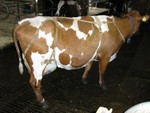
Ayrshire | |
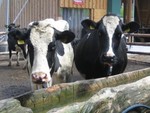
Holstein | |

Simmental | |
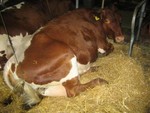
Pinzgauer | |
Dairy breeds
Ayrshire
Ayrshire is coming from Scotland. Now the most of the population is in northern Europe, like Russia and Scandinavian countries and also in Canada. Ayrshire is milk producer. Their yields are almost as high as Holsteins. Scandinavian countries have lot of efforts on Ayrshire’s breeding and the best bulls are Swedish SRB or Finnish Ayrshire.
Numbers from Finland (2003)
8010 kg - 4,28% - 3,42%
More information from Finnish Ayrshirebreeders and Finnish animal breeding association (FABA).
Holstein
The Holstein Cattle is the most common milk breed on Earth. It is bred in two colour lines (black and red) although there are no differences in the milk production. This breed is consequently bred for milk production and now they have some problems with healthiness. The genetic trend for the longevity stagnates since years and the relative account of the male calves and of the cows for slaughtering is very low. Also udder infections are a very big problem. Originally they were bred in Northern Germany/ Holland and in 1860 they were exported to America. Since 1970 some cattle form America were used for crossing with animals from Europe.
-
Milk production: 7.988 kg - 4, 15 % - 3, 27 %
-
Amount of cells: 170.000
-
Live production: 23.872kg
-
Longevity: 3,52 Years
-
Calving interval: 415 Days
-
Maximum production: 15.000kg Milk/Year
Red Holstein:
This line arises when you are crossing two cows which have the recessive alleles for the red colour. Through this change of colour the milk production is a bit lower than the milk production of black Holstein cows. This breed is perfect for crossing with Simmental Cattle and Pinzgauer, because the milk production is raising, but the colour stays the same.
Simmental
40 millions of Simmental Cattle are spread over the whole world. In the most countries it is known as a dual purpose race. Originally their beginning was in Switzerland in a valley called Simmental. Breeding of these big and spotted cattle was started in the middle ages. The cows were imported to Austria in 1830 and crossed with local breeds and the Simmental Cattle we have now was born. The middle-sized cow is light yellow – dark bay and sometimes has white spots. The head and the feeds are always white. The mouth is incarnate and the horns and claws are yellow like wax.
-
Milk production: 6.202 kg - 4, 19 % - 3,45 %
-
Amount of cells: 112.600
-
Live production: 21.022kg
-
Longevity: 3,82 Years
-
Calving interval: 393 Days
Simmental Cattle in Austria:
In Austria it is with 1.654.266 animals (=80%) the most common breed. About 250.000 cows are registered in a stud book and there are 12 breeding clubs.
Pinzgauer
-
5.185 kg - 3,89 % - 3,26 %
-
Austrian Population: 53.874
-
World Population: 1 Million
-
Very good meat quality. (58% usefull meat)
-
Dual purpose race: Bayer, Austria, North Italy
-
The use of meat: D, USA, BR, Namibia, AUS
-
A very good claw stability
-
They have a very good flexibility
-
They are well known for their maternal instinct
-
They have a better immune-system than high performance cows. ( Holstein)
Back to "Relation to housing and management"
Page updated 21.11.2005 |



