
Thin manure in the milking parlour | |
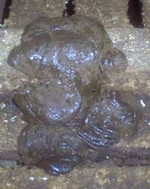
Hard manure from a dry cow | |
Slightly thin manure | |
Quality of manure
The components in manure follow feeding and they can differ greatly. When there's not enough structure in a cow's feeding, manure is thin. When there's a lot of structure in feeding, manure is thick. Here are links for more information about structure in feeding and manure.
A farmer we met in Finland used to give cows silage and concentrates separately and cows could select what they ate. Then manure was thin. Now he uses mixed feeding and cows can't select their food anymore and manure is of good quality.
How the roughage consistency affects manure quality
The old method to solve feeding problems by reading manure consistency has many advantages. It is cheap, fast and feeding mistakes are found out in a quite short time. You only need a filter, water and the know-how! This method gives you a lot of details from structure, starch, sugar and proteins of fodder which have a big admission to manure. Information is also given about mineral content, hygiene of fodder and water availability.
Fresh manure is graded in five groups:
|
type |
Attributes of manure |
mistake in feeding |
|
1 |
Very liquid
Only a flat puddle of manure |
Too much starch and/or sugar
Not enough cellulose
Soiled fodder
Fungi in fodder |
|
2 |
No heap of manure
It only gets max. 2,5 cm high |
Like in group 1
But also with fresh grazed pasture
|
|
3 |
Heap of ca. 4cm height
4-6 rings in cowpat |
Good feeding! |
|
4 |
Manure is a bit thick
Doesn’t stick on boots
With little rings/dimples |
A lot of structure, less starch and/or defect of the decomposition of proteins
(good feeding when the cow is dry or for heifers) |
|
5 |
Manure is very thick
Stack is 5-10 cm high |
Like group 4
But there also could be not enough water available
Or it could be from a sick cow |
Now put manure into a filter and wash it out with water:
When you have done did you grade the lag into three groups
|
type |
Attributes of the lag |
Mistake in feeding |
|
1 |
Many parts of undigested fodder (leaves)
A little bit green |
Fodder gets very fast by a rumen
Not enough rumination
Lots of concentrates
Fungi in silage |
|
2 |
High rate of maize corns and wheat |
Not enough chewing
Not enough rumination
Lots of concentrates
Maize was chaffed too early
Accelerated rumen passage |
|
3 |
Lots of little fibers |
Slow rumen passage
Lots of structure
Less starch and/or sugar
Typical for heifers and dry cows |
Page updated 16.5.2006 |



